
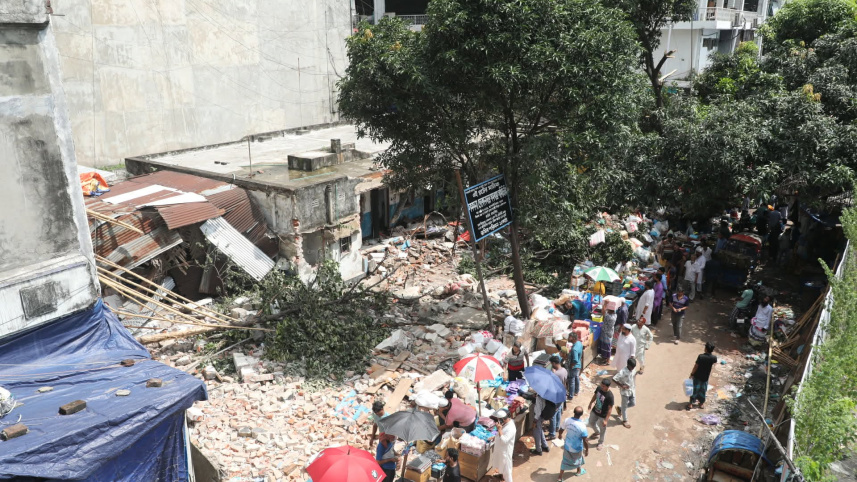
Under Cover of Night, Rudda Centre Razed to the Ground
Questions Mount Over the Health Minister’s Silence
The stillness of the night in Dhaka’s Mirpur-1 was shattered by an act of destruction without precedent. Security guards were bound and taken hostage as vandals descended on the Rudda MCH-FP Centre at midnight, unleashing a rampage of looting and demolition. More than two hundred masked assailants, armed with crude weapons, first overpowered the facility’s guards before systematically stripping the premises of valuable medical equipment, medicines, vaccines, cash, and other assets. But the attackers did not stop at looting — using heavy machinery, they reduced the entire complex, including one permanent and three semi-permanent buildings, to rubble.
The incident, which unfolded around midnight on Thursday, has given rise to a cascade of unanswered questions. How could such large-scale devastation be inflicted upon an established healthcare institution in the heart of the capital? Where were the responsible authorities while it was happening? And what has the Ministry of Health done in its aftermath?
The rampage is alleged to have been carried out under the banner of an organisation called the ‘Samomona Dokandar Samabay Samity Limited.’ According to Dr. Nasreen Akhter, Executive Director of the Rudda MCH-FP Centre, the destruction has caused losses exceeding one crore taka. She has since filed a case with Shah Ali Police Station.
Yet beyond the case filed at the police station, far graver questions have surfaced. How did such a large number of people manage to enter a healthcare facility in the first place? How were they able to carry out a prolonged campaign of destruction, armed with crude weapons and heavy equipment? Why did no swift legal or administrative response materialise even after the guards were taken hostage? And what concrete steps has the Ministry of Health taken since a long-standing healthcare institution was wiped out in this manner?
On Whose Orders Was This Devastation Carried Out?
Speculation is rife over the possible involvement of influential quarters behind the incident. Multiple sources suggest that an operation of this scale would have been all but impossible without the direction or patronage of some powerful figure — a possibility that warrants thorough investigation.
However, since no independent evidence for these allegations has yet come to light, the matter should for now be treated strictly as a subject of investigation. Uncovering the full truth will require scrutinising not only the perpetrators but also those who planned, financed, sponsored, and possibly wielded influence over the attack.
Where Does the Health Minister’s Responsibility Lie?
The most pressing political and administrative question arising from this incident now centres on the Ministry of Health. The Rudda MCH-FP Centre is no ordinary structure — it is an institution long and intimately associated with maternal and child healthcare.
Naturally, questions are mounting for the ministry led by Health Minister Sardar Sakhawat Hossain Bakul: what immediate action did the ministry take following such a devastating attack? Where will the affected patients now receive care? What account has been taken of the looted medicines and vaccines? What is the plan to rebuild the destroyed health infrastructure? And above all, how actively is the ministry working to ensure that those responsible are held accountable?
Critics argue that policymakers in the health sector were expected to respond to such an incident with far greater visibility and resolve. If questions remain about the ministry’s effective action, those questions deserve a clear public answer.
Until direct evidence of the Health Minister’s involvement in this devastation comes to light, he cannot be said to be implicated in the incident itself. But one distinction must be kept in mind —
the absence of evidence of direct involvement in an incident, and the existence of legitimate questions about administrative and political accountability for that incident, are two entirely different matters.
Given the responsibilities of his office, it is essential that the Minister’s position, the steps he has taken, and his directives be made unambiguously clear to the public.
Five Decades of Service, Reduced to Rubble in Hours
The Rudda MCH-FP Centre began its journey in 1974 with a mission to secure maternal and child healthcare for the underprivileged and low-income population of Mirpur. Established through the initiative of Radda Barnen, the Bangladesh arm of the Swedish organisation Save the Children, the centre had for decades run programmes in reproductive health and family planning, antenatal and postnatal care, child immunisation, child health, and community health outreach.
When an institution that has served people for more than five decades is wiped out in a single night, it is not merely the demolition of a few buildings. Bound up with it are the healthcare access of thousands of people, a vast quantity of public resources, and the continuity of a long-running public health programme.
Questions That Remain Unanswered
The central question now is this: will the destruction of the Rudda Centre end merely as a filed case, or will the full network behind it eventually come to light? And when it comes to safeguarding the security of healthcare institutions and the public’s right to medical care, exactly what steps has the Health Minister himself taken — will a satisfactory answer ever be given?
Until these questions are answered, the destruction of the Rudda Centre will remain far more than a mere case of vandalism — it will stand as a major test of accountability for the entire health sector administration.