
Health Minister’s Speech Ranges from Bay Gas to Teesta, but Where Is Health?
At a Manikganj political meeting, critics say health services took a back seat to energy and political issues
What should people hear from the country’s health minister? They want to know how struggling hospitals will improve, when shortages of doctors and nurses will be addressed, how patients’ difficulties at public facilities will ease, and how medicine supplies will be secured. Those questions remain central.
But Health and Family Welfare Minister Sardar Mohammad Sakhawat Hossain Bakul’s recent remarks ranged across energy, electricity, agriculture, water resources and foreign affairs, giving the impression that his address covered several ministries beyond his own.
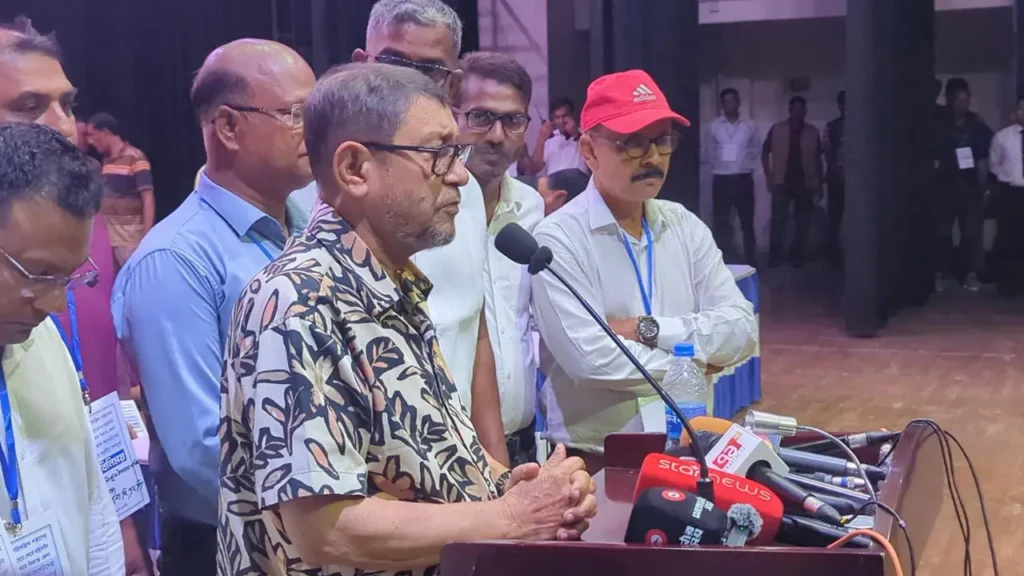
At a BNP views-exchange meeting at the Manikganj District Shilpakala Academy on Sunday (27 September), where he was chief guest, much of the minister’s lengthy speech concerned gas beneath the Bay of Bengal, extraction by India and Myanmar, Adani’s electricity, fertiliser, quick rental power plants, Indian influence, Farakka and the Teesta. He also spoke about political opponents.
Bakul said Myanmar was extracting gas on one side of the Bay of Bengal and India on the other. He claimed that Bangladesh also has vast gas reserves beneath the sea. He further said BNP leader Tarique Rahman had arranged for gas extraction from the Bay after discussions with the international community.
The minister also addressed Adani, the power shortfall, quick rental plants and fertiliser. While criticising past governments, he referred to political opponents, Indian “cohorts” and “fascists”. His remarks later turned to the Teesta Barrage and Chinese cooperation.
For a health minister, health was largely absent from the centre of the speech. That raises a basic question: what did he say about the ministry he leads?
Critics say the health sector still faces serious challenges requiring accountability. Patient pressure at public hospitals, limited beds, shortages of doctors and nurses, medicine supplies, rising treatment costs, emergency care, public health and hospital management all raise questions about government decisions and their implementation.
They argue that while the minister speaks at length on politics at meetings and rallies, the health ministry’s core problems receive less attention. They ask what crises he has identified since taking office, what has been resolved, and what specific targets he has set for the sector over the next year. They also want a clear public account of that work.
Critics frame the issue more directly: should the health ministry use political platforms to recount the failures of previous governments, or explain how it is addressing the problems facing the health system now?
Criticism of past governments is part of political debate. Disputes over the Adani power deal, quick rental plants, gas exploration or water management are not unusual. But critics say people also expect a serving minister to explain how current problems are being addressed, not only to list past failures.
That expectation is especially pressing for the health ministry. A political statement about electricity shortages may prompt a political response; when a patient cannot get treatment at a hospital, the consequences are immediate.
For patients, the amount of gas beneath the Bay of Bengal may matter, but access to a hospital bed can matter more. The Teesta Barrage may be an important issue, while a family facing an emergency needs to know whether an ICU bed is available. For a low-income household, the cost of treatment may be more urgent than the number of megawatts supplied by Adani.
The minister’s recent speech did include a plan to bring hospitals under solar power, a subject related to health infrastructure. Critics ask, however, whether hospitals will also have enough doctors and medicines, whether patients will receive the care they need, and how service quality will be maintained.
In critics’ view, the issue is not simply that the minister speaks; it is how he allocates attention among his responsibilities. Political speeches are expected at political events. But when the speaker also leads a vital public service ministry, that ministry’s work is bound to be part of what people expect to hear.
Debate can continue over gas reserves, India’s electricity supply, Adani’s reported cutbacks or plans for the Teesta. Yet health services affect people’s lives and finances every day. Critics’ central question is why the health minister’s public remarks have so little to say about the health ministry.
Ultimately, people do not judge a minister by the length of his speeches. They judge by their experience: the service available at a hospital, the time they wait, whether they receive needed treatment, and how much responsibility the state assumes for their care.