
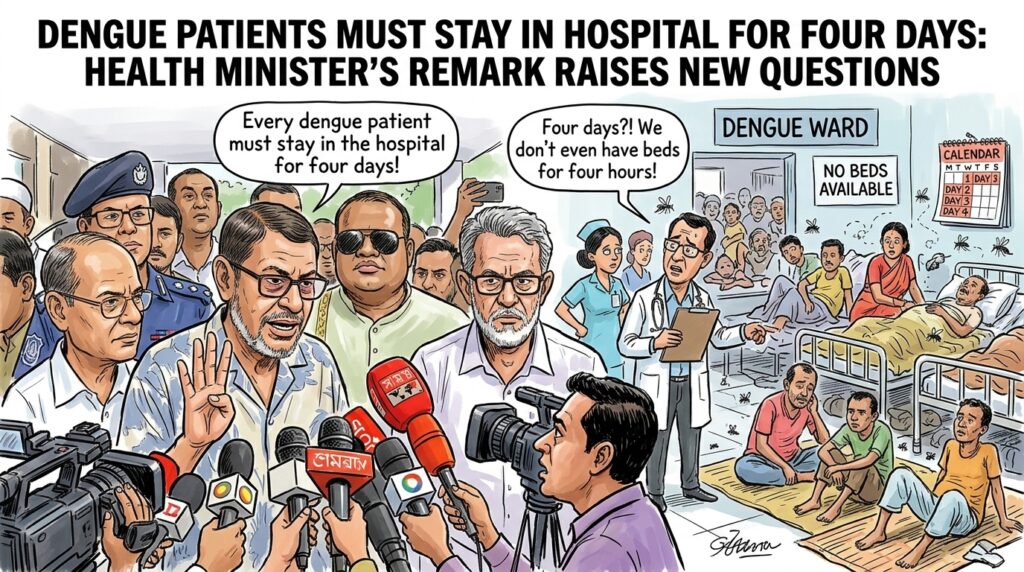
Dengue Patients Must Stay in Hospital for Four Days: Health Minister’s Remark Raises New Questions
As the number of dengue patients continues to rise across the country, pressure on hospitals is mounting by the day. With many government hospitals unable to accommodate the growing caseload, patients are being treated in corridors and verandas outside the wards. Against this backdrop, Health Minister Sardar Sakhawat Hossain Bakul has stated that dengue patients must remain under observation in hospital for at least four days. His remark has sparked fresh concern and questions among patients and their families.
Speaking recently on dengue treatment, the Health Minister said, “A dengue patient will remain under observation in hospital for four days; they cannot simply leave whenever they wish.” While there may be a sound medical rationale for keeping patients under observation, a section of patients and their relatives are questioning the statement given the current state of hospital management.
Their concern stems from the fact that government hospitals are already struggling to cope with the surge in dengue patients, so it is unclear how a mandatory four-day admission for every patient could be implemented in practice. Many hospitals currently lack sufficient beds relative to the number of patients. As a result, admitted patients are being squeezed into makeshift spaces, with some reportedly receiving treatment in verandas, corridors, or other unconventional areas.
Compounding this crisis is a shortage of manpower. Even as patient numbers have risen, the number of doctors, nurses, and other health workers has not increased proportionately, making it difficult to manage the additional caseload. This has raised further questions about whether admitted patients are receiving the standard of care they need.
Faced with inadequate services at government hospitals, many patients are being forced to turn to private hospitals and clinics. However, the cost of dengue treatment there is considerably higher, placing an added financial burden on low- and middle-income families. For many households, the combined cost of a few days’ treatment, tests, medication, and hospital fees can become a significant expense.
This has led patients and their families to ask: before enforcing a four-day hospital stay requirement, is the government ensuring that hospitals have adequate beds, doctors, nurses, and other essential staff?
There may well be a genuine need to keep dengue patients under hospital observation. In particular, doctors are best placed to determine the length of observation based on a patient’s physical condition, various blood parameters, blood pressure, dehydration levels, and the risk of complications. However, no two patients’ conditions are identical. Alongside any fixed time requirement, it is therefore important that doctors retain the flexibility to decide based on a patient’s clinical condition.
This is precisely where the core question about the Minister’s statement arises. In hospitals that already lack sufficient beds, making a four-day observation period mandatory could further intensify the bed shortage for new patients, adding pressure on hospitals and increasing the suffering of those waiting for admission.
According to a section of patients and their relatives, the Health Ministry’s priority at this moment should be to strengthen the capacity of government hospitals — ensuring adequate beds, increasing the number of doctors, nurses, and other essential staff, and arranging for necessary medicines and diagnostic tests. At the same time, they believe attention must also be paid to keeping the high cost of private hospital treatment within reach of ordinary people.
Their question is direct: if government hospitals lack adequate beds and manpower, will a mandatory four-day hospital stay actually ensure patients receive proper treatment, or will it deepen the existing crisis?
In tackling dengue, the decision to keep patients under hospital observation must be given equal weight alongside the issues of hospital capacity, staffing, and bed shortages. Simply fixing a duration for hospital stays does not, by itself, guarantee treatment; what is needed is adequate infrastructure, skilled manpower, and timely medical care.
In this context, following the Health Minister’s remarks, patients and their families are hoping that alongside the directive to keep dengue patients in hospital for four days, the Health Ministry will urgently address the shortage of beds and staff at government hospitals, the quality of medical care, and the treatment costs burdening ordinary people.