Smaller Screens, Higher Prices: Questions Grow Over Tender for 1,030 Dialysis Machines
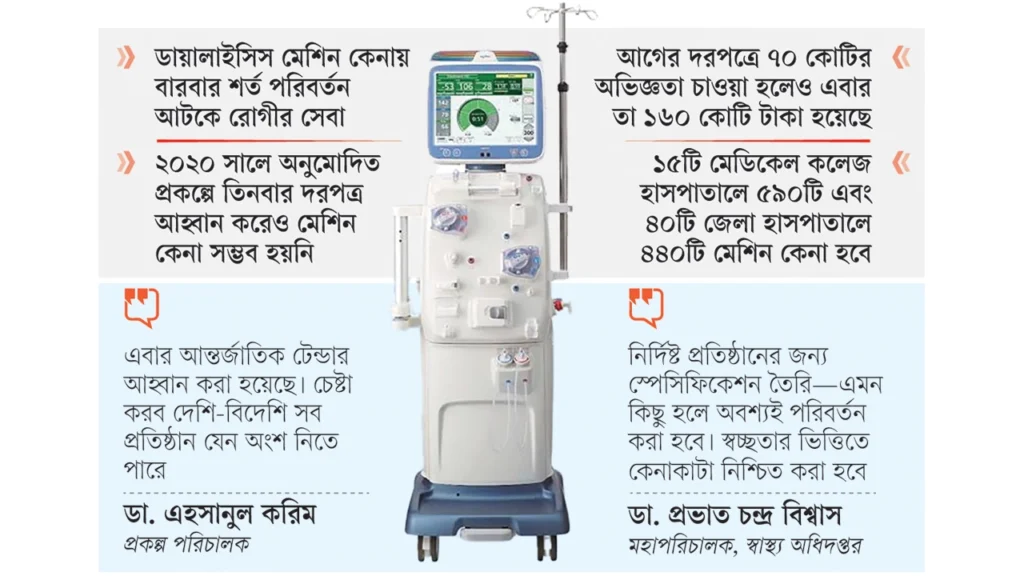
The monitor has shrunk from 15 inches to 10, yet the estimated price per machine has climbed from Tk 21 lakh to Tk 25 lakh. These changes in the Bangladesh government’s latest tender for 1,030 dialysis machines, a purchase meant to expand care for kidney patients, have raised fresh concerns. In effect, the proposal is to spend more on equipment with comparatively fewer features.
Nearly six years and three rounds of tendering have not completed the purchase. Key conditions have changed each time, prompting the question of whether those changes reflect patients’ needs or are designed to favour a particular company. The latest tender sets the supplier’s prior experience requirement at Tk 160 crore and also asks for experience of supplying and installing at least 1,030 machines.
A step back in technology?
People concerned with the process allege that the tender seeks machines with comparatively older single-pump, single-chamber technology instead of modern double-pump, dual-chamber systems. According to experts, machine capability is extremely important for critically ill patients, ICU patients and those with complex conditions.
The financial risk does not end at the point of purchase. If the machines create dependence on specific types of disinfectants and other supplies, the government’s long-term costs could rise even after the equipment is bought. If options for alternative suppliers of dialysers and related accessories are limited, the country could also end up reliant on a single company.
Tk 70 crore, Tk 1.5 crore, now Tk 160 crore
The project was approved in 2020 but was not implemented on schedule. The first tender sought Tk 70 crore in experience. The next cut that to Tk 1.5 crore. The latest has raised it to Tk 160 crore. What explains such dramatic swings? And why did a project that once called for modern machines with 15-inch monitors drop to 10 inches?
The project director has said that specifications will be changed if necessary after a review by the technical committee, and that efforts will be made to give all local and foreign companies a chance to compete. That statement is now the real test. If the goal is truly an open and competitive tender, what is the objection to explaining the unusual conditions in public?
How closely is the ministry watching?
A further question is how much oversight the highest levels of the health ministry are exercising over repeated specification changes in a purchase of this size. No evidence has emerged of the health minister’s direct involvement. But does the minister know how, and on whose recommendation, these technical conditions are being changed?
If a particular company has benefited, the public has a right to know whose influence lies behind it. At stake are the lives of thousands of kidney patients, public money and treatment costs for many years to come.
Five questions that need answers
Before buying the 1,030 machines, the government must state its position clearly on at least five points:
- What is the technical rationale for reducing the monitor from 15 inches to 10 inches?
- Why is the estimated price rising for a machine with fewer features?
- What is the basis for the Tk 160 crore experience requirement?
- Will the purchase create future dependence on a particular company’s dialysers or chemicals?
- Most importantly, were the tender conditions changed to benefit a particular company?
If kidney care becomes an opening for business interests, patients and the state will ultimately pay the price. This tender therefore needs both technical transparency and accountability at the ministry level. The purchase will be made with public money, and the question of who benefits must be answered before it goes ahead.