
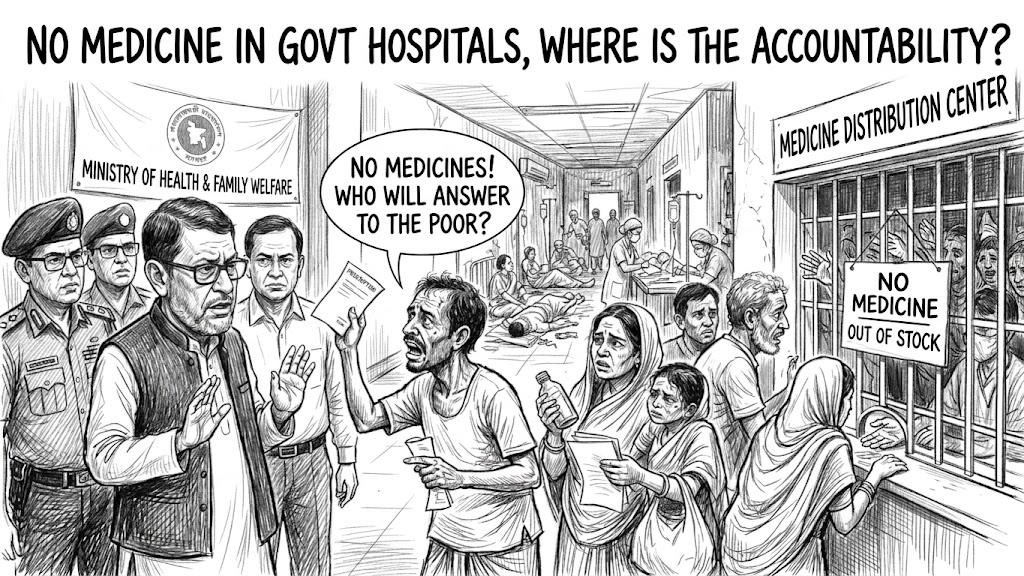
Medicines Missing in Three-Quarters of Cases: Who Is Responsible for the Failure of Public Healthcare?
Government hospitals are the last resort for poor patients, yet medicine stores stand empty, with no clear explanation or roadmap for a solution
For poor people, a government hospital is the last refuge. But even there, essential medicines are not available, according to an opinion article published in Jago News. The PPRC survey cited in the article found that in the 22 government healthcare institutions reviewed, the availability of essential medicines was only about 22 per cent.
If, even after this information became public, the ministry’s leadership cannot offer a clear explanation and a swift solution, the matter is no longer just one of weak management. It becomes a failure of accountability.
Worse in the Larger Hospitals
According to the article, the availability of essential medicines in tertiary-level hospitals is only 11.5 per cent, and at the secondary level 23.9 per cent. Where patients’ conditions are most complex, medicine supply is lowest. This suggests that the crisis is not merely a shortfall in total supply. There is a serious flaw somewhere in the distribution and management of medicines, so that they are not reaching the places where they are needed.
Who Is Responsible
The entire management of purchasing, stocking, and delivering medicines to patients is the responsibility of the Ministry of Health and Family Welfare. The ministry is headed by Minister Sardar Md. Sakhawat Hossain, so questions about this failure point directly at him. Responsibility cannot be brushed aside by saying that supply did not arrive. Finding out why it did not arrive, where it got stuck, and who is to blame, and then offering a solution, is the ministry’s own job.
Unless it becomes known which hospitals face the worst shortages, where medicines are held up and what the responsible officials are doing, it is natural for questions to be raised about the minister’s leadership.
Patients’ Rights and the State’s Promise
When medicines are not available at a government hospital, patients are forced to buy them with their own money. For those who cannot afford to, treatment remains incomplete, doses are reduced, and sometimes treatment stops altogether. The shortage of medicines is therefore no minor administrative flaw. It involves people’s right to life and health, and the state’s promise on healthcare.
A Structural Problem, Yet the Responsibility Is Present
The article says the problem is long-standing. But the current leadership cannot escape responsibility by pointing to past weaknesses. If, even after taking office, up-to-date stock information, the reasons for supply obstacles, and a timeline for ending the shortage remain unknown, the question of where the accountability lies is a fair one.
Not Assurances, but Proof
What is now expected from the minister is not general assurances but visible steps and an account of results. The public wants public answers to at least three questions: what medicines, and how much, are in stock at each hospital; where and why supply is stuck; and how long it will take to end the shortage and which officials hold which responsibilities. Making this information public will be the real test of the minister’s leadership.
Getting medicines into patients’ hands is the government’s responsibility. The minister, too, must answer for any failure to fulfil it.