
Empty Lab, Busy Brokers: What the DMCH Sample Scandal Reveals About Bangladesh’s Public Healthcare
The allegations go beyond petty brokering. They point to a parallel trade built on patients’ helplessness and put the health minister’s anti-syndicate pledge to the test
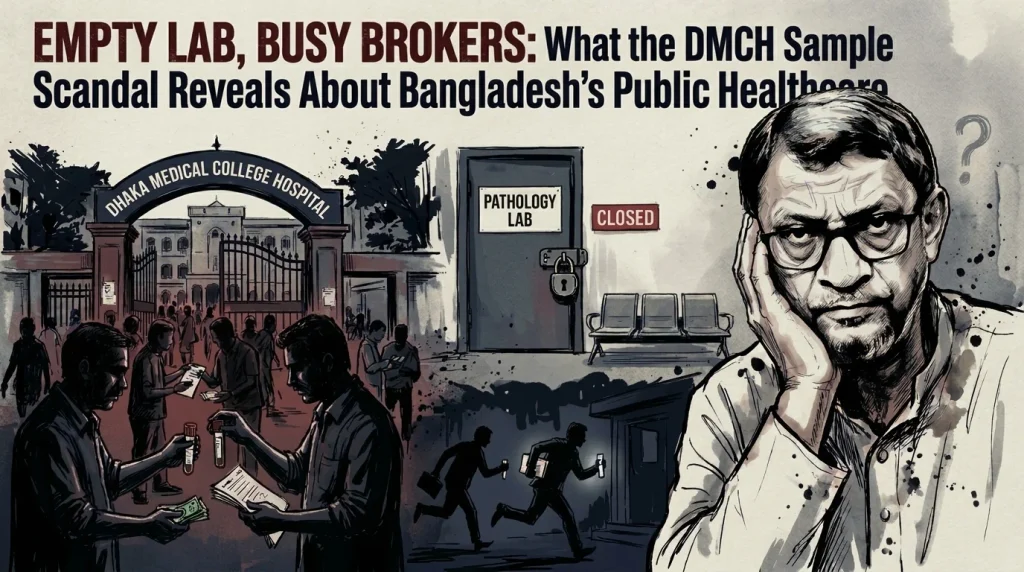
For millions of poor and critically ill Bangladeshis, Dhaka Medical College Hospital is the last resort. Most of those who come through its gates cannot afford a private hospital. That is precisely what makes the allegations unearthed by a Somoy News investigation so disturbing: inside this very hospital, patients’ test samples are allegedly being diverted to private labs by brokers working the wards at night.
A parallel market inside a public hospital
The investigation describes broker networks around the gynaecology, medicine, surgery and emergency departments. Young men were found in a doctor’s room in the gynaecology ward at 11 pm, collecting test slips handed out by doctors. At 3 am, one took Tk 2,450 from a maternity patient’s husband. Samples were then allegedly ferried to a diagnostic centre in the Panthapath–Green Road area that looks closed from the street but works through the night, receiving samples, by one insider’s account, as often as every 15 minutes.
Meanwhile, DMCH’s own pathology sample counter was found nearly deserted.
Why this is more than a money problem
Overcharging vulnerable families is bad enough. The greater danger is clinical. When samples change hands informally at night, basic safeguards are left in doubt:
- Chain of custody: who authorised the sample to leave the hospital, and was the patient’s consent obtained?
- Sample integrity: how are identity and proper storage ensured in transit?
- Lab quality: who checks the outside lab’s licensing, trained staff, equipment, and calibration?
- Report reliability: a wrong result can mean wrong drugs, wrong treatment, unnecessary surgery, or a life-threatening decision.
An oversight gap at the top
DMCH Director Brigadier General Farhad Hossain said the hospital offers all tests, that he was unaware of samples being sent out, and that action would follow an investigation if anyone were found involved. Taken at face value, that response itself exposes the problem: if strangers can sit in a restricted ward’s doctors’ room, collect cash and move samples out repeatedly without the administration knowing, the hospital’s internal monitoring has failed.
A test for the health minister
Bangladesh’s leadership has repeatedly pledged to break syndicates and bring discipline, transparency and accountability to the health sector, and the current health minister carries that mandate. The DMCH allegations turn that rhetoric into a practical test. An impartial probe would need to examine the role of hospital management, department heads, doctors, staff and those transporting samples, along with the licensing and standards of the outside lab.
The bigger question is whether DMCH is an exception or a symptom. If this can happen at the country’s flagship public hospital, similar networks may exist at other medical college hospitals, district hospitals and upazila health complexes. One investigation at one hospital will not answer that. Central oversight of how samples are collected, tested, reported and referred across the public system would.
A patient comes to a hospital to be treated, not to be held hostage by brokers. Whether the ministry acts decisively, or this network too stays beyond reach, will say a great deal about how seriously that principle is taken.