
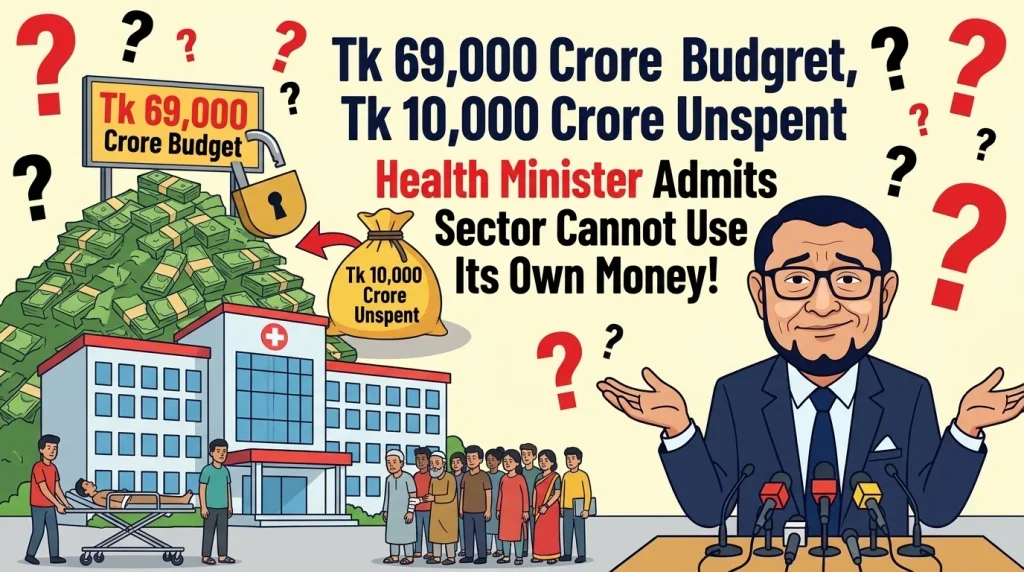
Tk 69,000 Crore Budget, Tk 10,000 Crore Unspent: Health Minister Admits Sector Cannot Use Its Own Money
Acute shortages of doctors and nurses, muddled recruitment figures, and stalled projects: the minister acknowledged them all, then asked for one more year before improvements become visible. Can patients afford to wait?
Bangladesh’s health sector has been allocated around Tk 69,000 crore in the current fiscal year, yet nearly Tk 10,000 crore of it is set to be returned through the supplementary budget because development project proposals (DPPs) could not be prepared and implemented on time, Health and Family Welfare Minister Sardar Md. Sakhawat Hossain has said.
The minister made the disclosure on Wednesday, 25 November, as chief guest at the dissemination of a report titled “Projection of Health Workforce Demand and Supply in Bangladesh by 2040”, jointly organised by the Directorate General of Medical Education and the World Health Organization (WHO) at Hotel Pan Pacific Sonargaon in the capital.
Roughly one in every seven taka set aside for health will go unspent, in a sector already short of hospital beds, doctors, nurses, medicines and essential equipment. That raises an uncomfortable question: who is accountable for the officials responsible for drafting, approving and executing these projects?
Four recruitment figures, no clear picture
Manpower remains the health system’s most pressing problem. Public hospitals are overwhelmed relative to their staff, and keeping doctors in rural and remote areas has become increasingly difficult because of weak incentives and poor working conditions.
The minister said steps had been taken to recruit doctors and nurses. However, his speech cited several different numbers at different points: more than 5,800, 5,000, 5,835 and 8,538. It was not made clear which figure referred to which recruitment process, which posts, or which timeframe.
He also spoke of plans to recruit or train 25,000 midwives and one lakh (100,000) health workers. Without a clear timeline, funding source, progress report, and field-level posting plan, however, headline numbers alone will not solve the workforce crisis.
“One more year” — and patients in the queue
The minister indicated that visible improvement in the health sector could take another year. For patients standing in long queues to see a doctor, mothers travelling from upazila to district hospitals with sick children, or families forced to buy tests and medicines from outside, today’s treatment matters more than tomorrow’s promise. Real progress must be measured in service quality, doctor attendance, nurse numbers, drug availability, and lower out-of-pocket costs.
Dengue: not just a citizens’ problem
On dengue, the minister pointed to public behaviour, stagnant water in homes, clogged drains and weak waste management. Public awareness is undeniably important. But identifying and destroying breeding sites, running regular clean-up drives, clearing drains and maintaining effective surveillance are the responsibility of local government bodies and the relevant authorities. Any honest assessment of failure must examine institutional preparedness and coordination alongside individual behaviour.
Cancer remarks need scientific care
Referring to a conversation with the chief executive of a foreign hospital, the minister linked breast and cervical cancer risk to not having children, not breastfeeding and not marrying.
Such remarks require careful scientific framing. Breast cancer risk is shaped by many factors, including age, family history, genetics, reproductive history and lifestyle. Cervical cancer, by contrast, is caused mainly by persistent infection with high-risk strains of the human papillomavirus (HPV). Presenting being unmarried or childless as a direct cause of cervical cancer is not scientifically accurate, and coming from a policymaker, such claims risk spreading misconceptions.
HPV vaccine coverage claimed at 90 percent
The minister said HPV vaccination coverage, once just 2–3 percent, has risen to around 90 percent, with nearly 19 lakh (1.9 million) girls aged 10–14 vaccinated. The target is full coverage within the next three months. This is a significant public health initiative, but the basis of the 90 percent figure the period, the target population, and the data source should be published, along with separate figures for first-dose uptake and completed courses.
Accountability, not announcements
Why could nearly Tk 10,000 crore not be spent? Which projects failed? How far have the recruitment pledges progressed, and when will hospitals finally be adequately staffed? Until these questions are answered, the health sector’s progress will remain visible only in budget figures and podium speeches, not in hospital wards.