
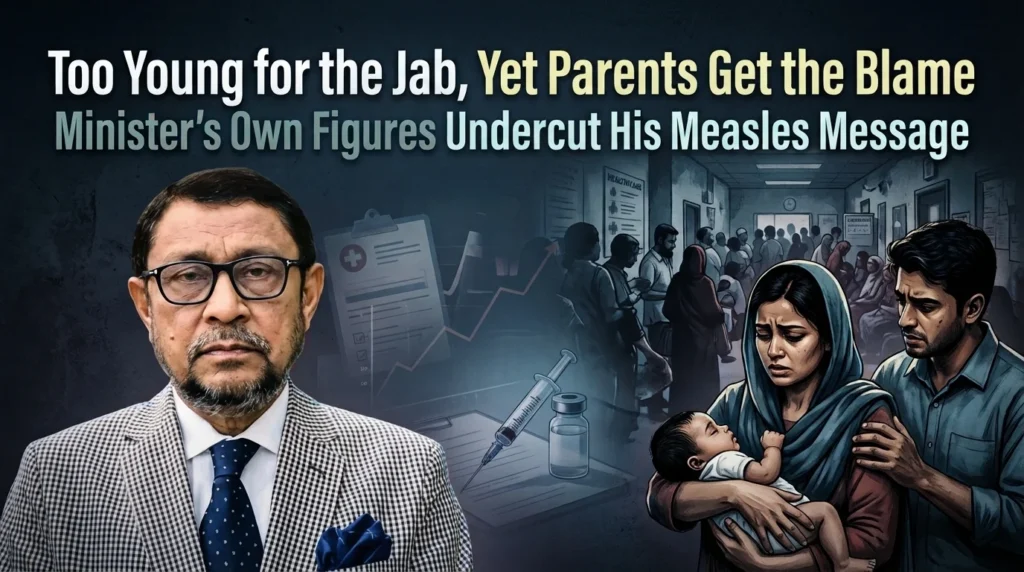
Too Young for the Jab, Yet Parents Get the Blame: Minister’s Own Figures Undercut His Measles Message
Up to 70 percent of infected children are under six months old, an age at which they cannot be vaccinated, pointing to a breakdown in community immunity rather than parental neglect
The health minister has said that not a single child being treated for measles had been vaccinated. But his own figures tell a more uncomfortable story: between 60 and 70 percent of those infected are younger than six months, an age at which international protocol does not allow routine measles vaccination.
Speaking yesterday, the minister also acknowledged that around 1.5 million children in the country remain outside the vaccination net.
Explaining why eligible children had missed their shots, he listed reasons given by mothers. Some said they were not at home. Some said they avoided taking the child to a doctor because the child cries. Others said they never heard about the vaccination drive at all.
A gap in the shield, not just in households
Infants too young to be vaccinated depend on the people around them for protection. When enough of a community is immunised (for measles, typically around 95 percent with two doses), the virus struggles to spread and reaches the youngest far less often. This is known as herd immunity.
A surge of infections among babies under six months is therefore a warning sign that this protective barrier has weakened. It raises questions about real vaccination coverage, regional disparities and the effectiveness of disease surveillance, none of which can be answered by pointing at individual parents.
“We didn’t hear about it”: whose failure?
Several of the reasons the minister cited point back to the system itself. If parents never learned about the vaccination campaign, that reflects gaps in public communication and field-level outreach. Identifying every child, telling families when doses are due, and tracking down those who miss them are core functions of a national immunisation programme.
Likewise, parents being away from home raises the question of whether vaccination schedules and locations work for working families and those who move frequently.
Hope, but no timeline
The minister said health workers are now going door to door to reach the remaining children, and expressed hope that infections would fall once they are vaccinated. He did not say when the drive will end, how many children it aims to reach and by when, or what targets have been set for each district.
Shifting the blame to parents may be convenient. But 1.5 million unvaccinated children and widespread infection among infants too young for the vaccine suggest that accountability should begin with the immunisation system itself.