
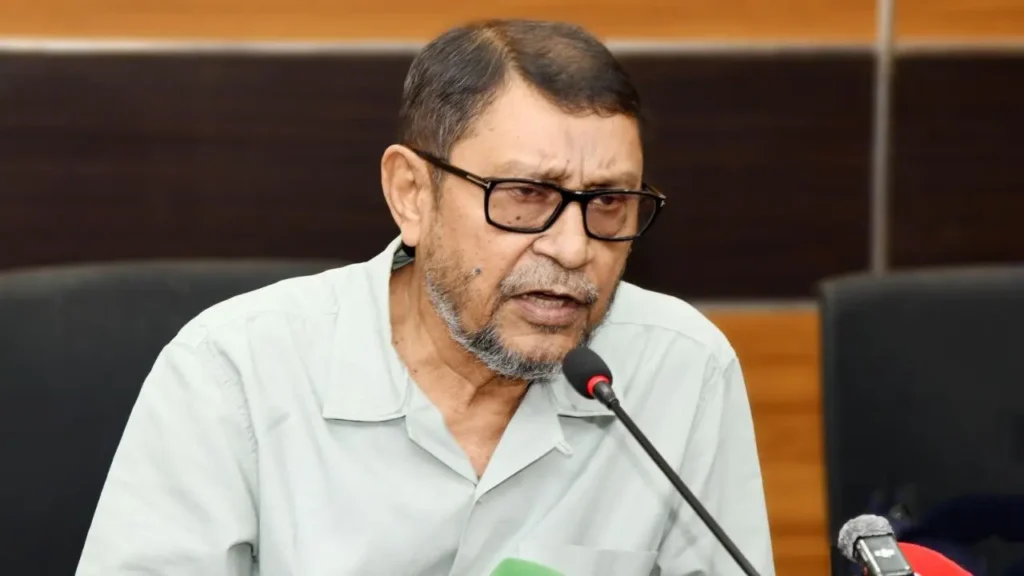
“Doctors Will Go After Patients” — But Each Doctor Already Has 1,400 People Depending on Them
The health minister’s pledge that doctors will go to the people has brought the country’s workforce shortage into sharp focus
The promise: healthcare will no longer be confined within hospital walls; doctors themselves will go to the people. The reality: long queues at outpatient departments of government hospitals and long waits to see a doctor. It is this gap between the health minister’s words and the picture on the ground that is now at the center of the debate.
It is easy to say that doctors will reach out to people. The hard part is producing enough doctors to go, and enough health workers to stand beside them.
The Numbers: About 1,389 People per Doctor
According to a report by The Business Standard, Bangladesh has roughly 0.72 to 0.73 registered doctors per 1,000 people. In plain terms, each doctor carries a load of about 1,300 to 1,400 people on average. Taking 0.72, the figure comes to roughly 1,389.
Data from the BMDC and various surveys put the number of registered doctors at around 130,000 to 137,000. The figure looks large, but it is small against a vast population. And what matters more is who is where within that number: some are in government institutions, some in the private sector, some abroad, some in administrative roles. Without looking at this distribution, no one can claim that there are “enough doctors.”
The national average has another limitation. The capital and the big cities cannot be compared with remote upazilas, char areas, haors, or hard-to-reach regions. In some places there are comparatively more doctors; in others, even where posts exist, ensuring regular attendance and service is difficult.
No One Beside the Doctor
Healthcare is not one person’s job; it is a team effort. The World Health Organization’s widely cited benchmark calls for about three nurses and five other health workers for every doctor, a ratio of 1:3:5. Bangladesh’s picture, according to recent data cited in the report, is about 1:0.74:0. There are doctors, but no team has grown around them.
The effect falls directly on patients. Beds are scarce in emergency departments and ICUs, and staff shortages and patient pressure are constant. Treatment also stays incomplete without continuity across tests, nursing, medication, monitoring, surgery and follow-up. Even if a doctor goes to the patient, the question is whether all of this will go along.
What It Will Take to Keep the Promise
For the promise to become real, the foundation must be laid in primary healthcare. Every union and upazila needs enough doctors, nurses and community health workers; diagnostic facilities, medicines and a digital referral system; and doctors who are present at their posts and held accountable.
The Final Question
The aspiration is undoubtedly a good one: healthcare should move from the hospital door to people’s doorsteps. But the question is no longer just whether doctors will go after patients. It is whether the state has been able to train enough doctors, nurses, and health workers to do so. If there is no answer, the distance between fine words and field realities will only grow.