
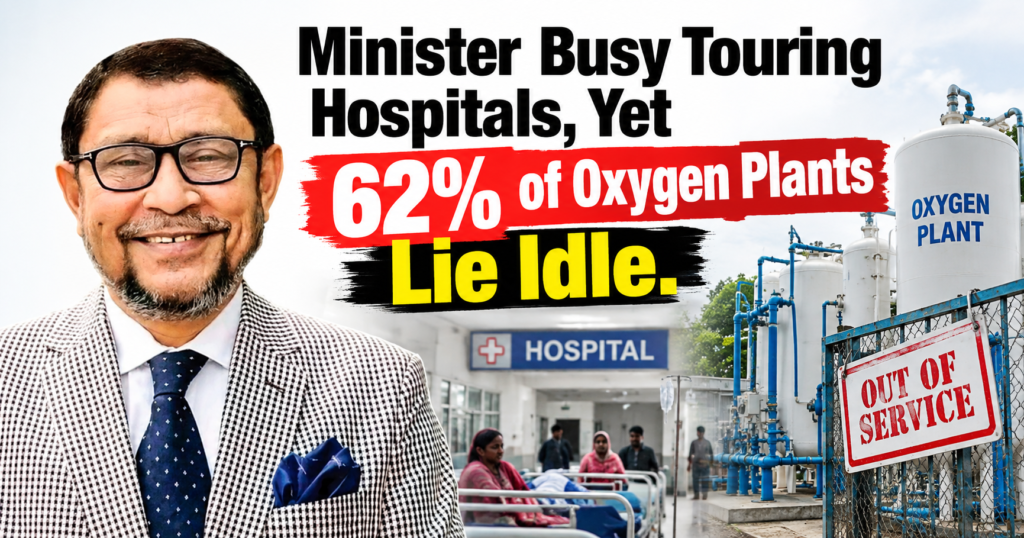
Minister Busy Touring Hospitals, Yet 62% of Oxygen Plants Lie Idle
Is checking toilets, meals and attendance the real priority? Questions grow over action on the life-saving oxygen crisis
The health minister appears to be spending much of his time on hospital visits. One day it is one district, the next day another. Arriving unannounced, he checks whether officials are at their posts, how good the patients’ meals are, and whether the toilets are clean. Cameras follow him, and afterwards, before the press, come the announcements one after another: this will be fixed, that will be improved, action will be taken.
Behind the Visible Activity
Yet a pointed question is growing louder: beyond these visible efforts, where is the minister’s effective action on the most urgent crises facing the country’s health system? Hospital infrastructure, shortages of doctors, nurses and other staff, irregular medicine supply, weak emergency care and the life-saving oxygen system all bear directly on whether people live or die. In such circumstances, should the cleanliness of a toilet or the absence of a single official really be a health minister’s top priority?
62% of Oxygen Plants Out of Order
A recent report has exposed a grim picture of oxygen plants in public hospitals. According to it, 62 percent of the oxygen plants in government hospitals are not working. Oxygen is not a hospital embellishment; for a critically ill patient it is among the most basic means of staying alive. Even after such a serious reality came to light, how much weight the issue carries in the minister’s public statements remains the central question.
Inspection Is a Duty, Not the Final Word
Checking staff attendance, patients’ food and hygiene during hospital visits is undoubtedly part of administrative responsibility. But a health minister’s duty does not end with inspection; ensuring lasting solutions to the problems found is equally his job. Saying “action will be taken” before cameras does not transform a health system. What is needed is regular monitoring, accountability, proper use of the budget and a dependable maintenance system.
This is precisely where criticism of the minister’s conduct arises. The visits are easy to see, but whether visible and measurable results are emerging on the system’s structural problems is still unclear to ordinary people.
Where Do the Priorities Lie?
At times, the minister’s remarks also stray beyond the health portfolio, touching on matters such as extracting gas from the Bay of Bengal. When oxygen plants in hospitals sit idle, and the ministry’s top policymaker gives more airtime to offshore gas exploration than to that crisis, it is natural to ask where the health ministry’s priorities truly lie.
What the Public Expects
The public’s expectations are not extravagant. They do not want merely to know who was present and who was absent. They want answers, and solutions, to why doctors are in short supply, why equipment lies broken, why oxygen plants cannot be kept running, and why patients must rush to private hospitals for essential care.
The surest route to popularity in the health sector is probably not a surprise visit to a hospital. It is a public health system where patients receive timely treatment and the medicines they need, do not scramble for oxygen, and do not depend on a minister’s sudden appearance to get proper service.
The Real Test
Visiting hospitals before the cameras is easy. Reviving idle oxygen plants, ending years of mismanagement and repairing deep structural weaknesses is far harder, and that is the minister’s biggest test now. The question, therefore, is a single one: will the minister confine himself to visible activity, or will he prove effective leadership by finding lasting answers to life-and-death issues such as the 62 percent of oxygen plants that stand idle?