Bricks Before Doctors: Bangladesh’s Tk 57,000 Crore Hospital Gamble
With more than 23,000 health posts lying vacant, the government is racing to build and still has no finished plan for who will staff the new wards
Bangladesh is preparing to spend nearly Tk 57,000 crore on new and expanded hospitals across its upazilas and villages. On paper, it is one of the most ambitious health infrastructure drives in the country’s history. In practice, it risks producing gleaming buildings with no one to run them.
A crisis measured in empty posts
According to figures placed before Parliament in June, 23,223 posts in the public health sector are vacant: 9,407 for doctors, 5,032 for nurses and 8,784 for other health workers. The Bangladesh Health Workforce Strategy 2024 adds that roughly three-quarters of government doctors and nurses work in urban areas. The shortage is sharpest exactly where the new money is headed: the upazilas and rural unions.
Where the money goes
The Directorate General of Health Services has proposed two projects worth Tk 56,750 crore: Tk 44,757 crore to expand upazila health complexes and Tk 11,993 crore for an integrated rural primary care network. Construction alone accounts for Tk 19,561 crore and medical equipment for another Tk 12,015 crore. The plans include:
▪ Brand-new 151-bed hospitals in 24 upazilas
▪ Replacing dilapidated 31-bed buildings in 83 upazilas with 132-bed facilities
▪ Multi-storey integrated service buildings in 440 upazilas
▪ Building or renovating 16,265 facilities at union and ward level
The projects also promise ICUs, coronary care, dialysis, stroke treatment and cancer screening at upazila-level services that demand highly specialised staff.

The missing piece: people
The rural project alone calls for 56,222 staff, including 14,661 new posts. Yet the health ministry says its integrated workforce plan is still being prepared, and the Planning Commission has itself questioned whether that plan has been finalised. Manas Mitra, joint chief of the commission’s health wing, insists the projects are not just blanket construction. But a country that has struggled for years to fill its existing vacancies needs more than assurances.
Lessons ignored
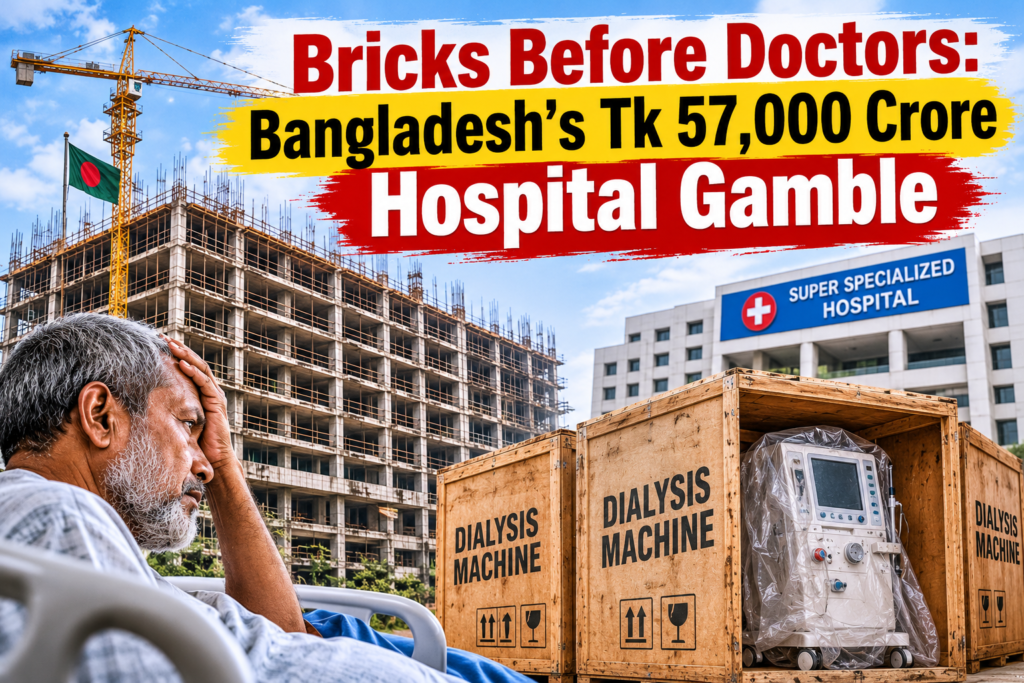
President Mirza Fakhrul Islam Alamgir recently acknowledged that equipment bought in the past still lies boxed up in many places, and that dialysis machines sit idle for lack of trained hands. Against that admission, a fresh Tk 12,000 crore equipment budget looks less like reform and more like repetition.
What experts say
Professor Syed Abdul Hamid of Dhaka University’s Institute of Health Economics argues that existing hospitals must be made functional first, with any expansion tied to local demand and secure running costs. Dr Abdur Razzaque Sarker, a senior research fellow at BIDS, warns that buildings and machines installed without trained staff are likely to sit unused.
A better order of business
This year’s health budget of Tk 69,409 crore, the first ever above 1 percent of GDP, is a genuine opportunity. To make it count, the government should:
1. Set a firm deadline for filling existing vacancies
2. Make a costed staffing plan a condition of project approval
3. Offer real incentives to keep doctors and nurses in rural postings
Hospitals are built with cement. Health care is built with people.
Source: Dhaka Mail, 10 November 2026.