
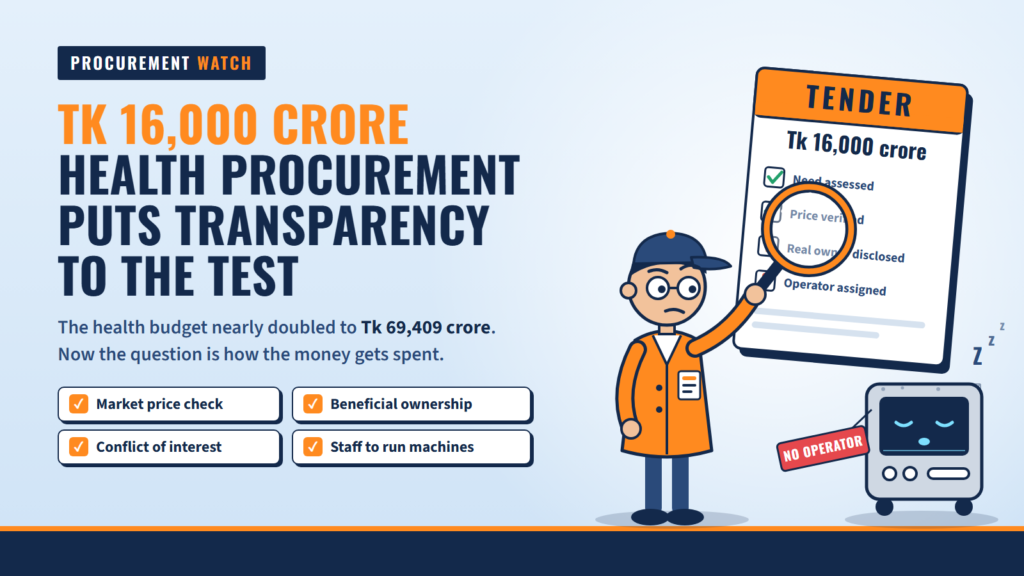
Tk 16,000 crore health procurement puts transparency to the test
With the health budget nearly doubled to Tk 69,409 crore, the real measure of success will be how the money is spent, not how much has been set aside.
Bangladesh’s health sector has received one of its biggest funding boosts in years, with the allocation rising to Tk 69,409 crore, nearly double the previous level. But as the Ministry of Health and Family Welfare prepares to roll out purchases and tenders worth around Tk 16,000 crore, the focus is shifting from the size of the budget to the integrity of the spending.
The procurement drive is both a major opportunity and a major risk. Large public purchases tend to raise the same three questions: how competitive the tenders really are, whether the prices paid are reasonable, and how the need for each item was decided in the first place.
Before that much money leaves the treasury, the public expects clear answers on where it will go, why, and what difference it will make to people’s lives.
e-GP alone is not a guarantee
Running tenders through the electronic government procurement (e-GP) system does not on its own make a purchase transparent. Market price checks before tendering, disclosure of suppliers’ beneficial ownership, screening for conflicts of interest, verification of product quality and scrutiny of purchase prices all need to be independently verified.
Without those safeguards, a tender that ticks every box on paper may still fall short when judged against the public interest.
Equipment that nobody can operate
Complaints about expensive machines lying idle in government hospitals are nothing new. Before any equipment is bought, one question has to be answered: are the technologists, reagents, electricity supply, infrastructure and maintenance arrangements in place to run it?
A machine with no technologist to operate it, no reagents to run tests, or one that breaks down within months, does nothing for patients. The yardstick this time should not be how many machines are bought, but how many patients are treated with them.
Buildings without staff
A hospital with new buildings and equipment but no doctors, nurses, or technologists cannot serve patients effectively. Unless the new purchases are matched by filling vacant posts, deploying staff where they are needed, training, and hospital-level workforce planning, part of the investment risks becoming little more than an infrastructure showpiece.
A role for citizens
Procurement on this scale should not be confined to the internal processes of government offices. Civil society, health experts and professional bodies should be given room to monitor it, while independent audits and post-purchase evaluations should be made mandatory.
Every machine, medicine and piece of equipment bought with public money ultimately belongs to the public.
The Tk 69,409 crore allocation hands the government a significant opportunity, and the Tk 16,000 crore procurement will be its practical test. Whether the extra money transforms the health sector or simply inflates public spending will depend on one thing: whether patient care, rather than the size of the bill, becomes the measure of success.