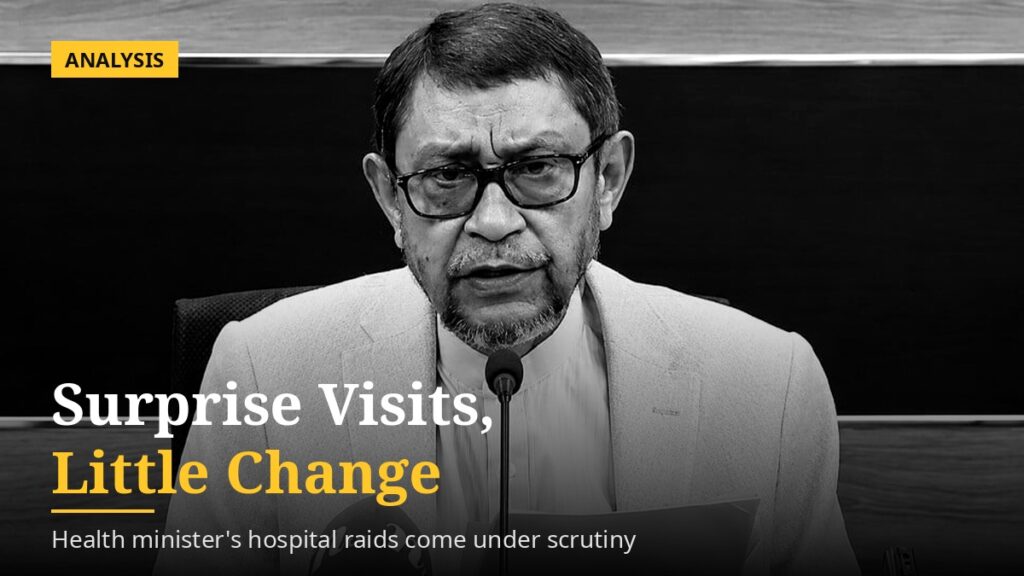
Surprise Visits, Little Change: Health Minister’s Hospital Raids Come Under Scrutiny
Since taking charge of the health and family welfare ministry last February, Sardar Md. Sakhawat Hossain Bakul has made unannounced visits to at least 30 hospitals, among them facilities in Satkhira, Naogaon, Jhenaidah, Kushtia, Cumilla, Habiganj and Sylhet. He has toured wards, pharmacies and even kitchens, ordering transfers or suspensions where staff were missing from their posts and voicing displeasure elsewhere. Videos of the visits have spread on social media. Yet a field check by bdnews24.com suggests the effect is largely cosmetic: hospitals look tidier for a few days, and little else changes. The question now is whether surprise raids can raise the standard of healthcare at all.
Cumilla: four months on, the same dirt
When he visited Cumilla Medical College Hospital on 5 May, the minister said he hoped the fear of his visits would, at the very least, improve conditions. Four months later, reporters found waste and leftover food piling up in the corners of the medicine, paediatric and gynaecology wards. Open containers of medical waste gave off a stench, and the lift used by patients and their relatives was also used to move waste. Used syringes lay near stairways and outside the dental department. Agriculture, Fisheries and Livestock Minister Aminur Rashid Yeasin, who chairs the hospital’s management committee, also asked for urgent action on the toilets; a month later, nothing visible had changed. The acting director says the hospital needs 126 cleaners but has only 53.
Habiganj and Sylhet: improvements fade, promises lapse
At Habiganj Sadar Modern Hospital, which the minister visited on 29 August, patients and relatives say cleanliness and service improved briefly before slipping back within days. Many still buy most of their medicines from outside, have tests done elsewhere, and complain of broken equipment and nurses who do not always respond. The minister had promised more doctors and beds that day, but no progress could be found.
At Sylhet’s MAG Osmani Medical College Hospital, the minister said in early September that all problems would be solved within seven days. Now the cardiac ward holds 120 patients against a capacity of 40, its bathroom reeks, and the floor is slick with water and dust. The 900-bed hospital treats around 3,000 patients every day. It needs 500 to 600 cleaners and has 262. An assistant director claims there has been visible improvement; patients’ accounts and the reporters’ own observations do not bear that out.
Where the criticism lands
First, the minister is chasing symptoms rather than causes. Shortages of staff, medicines, equipment and beds are matters of policy and budget, and they rest with the ministry. A hospital with nearly three times its capacity in patients cannot stay clean out of fear of an inspection.
Second, accountability is missing. A seven-day promise that goes unmet raises the question of who answers for it. There is no visible mechanism for reporting back after a public pledge.
Third, blame is being pushed downward. Some doctors say absences and behaviour get the attention while failures in laboratories, administration, stores and supply chains stay out of view. Dr Asif asked whether keeping a pathology lab running is the doctor’s duty alone.
Fourth, public rebukes and on-the-spot punishment risk setting patients against doctors and raising the danger of public anger or assaults on doctors. The secretary general of the Doctors’ Association of Bangladesh accepts the minister’s right to inspect but says any complaint should be investigated under the rules before action is taken.
Fifth, governance by camera. Dramatic footage generates debate, not better care; as Dr Asif put it, a health system is not a film.
The minister’s defence, and its limits
The minister says the public is benefiting. He argues that acting on absent doctors is his duty, that show-cause notices are issued first, and that action follows the rules if replies are unsatisfactory. On staffing, he points to a plan to recruit 100,000 health workers and to supply equipment down to the upazila level. These are welcome intentions, but the report mentions no timeline or roadmap. He is entitled to inspect hospitals; the issue is whether inspection alone can pass for a solution.
What needs to happen
Recruitment with firm deadlines, restoration of outsourced cleaner hiring, a dependable flow of medicines and equipment, and continuous, publicly reported monitoring of each hospital matter more than any single raid. Without them, every visit will deliver a few days of polish, and patients will carry on suffering as before.
Source: bdnews24.com