
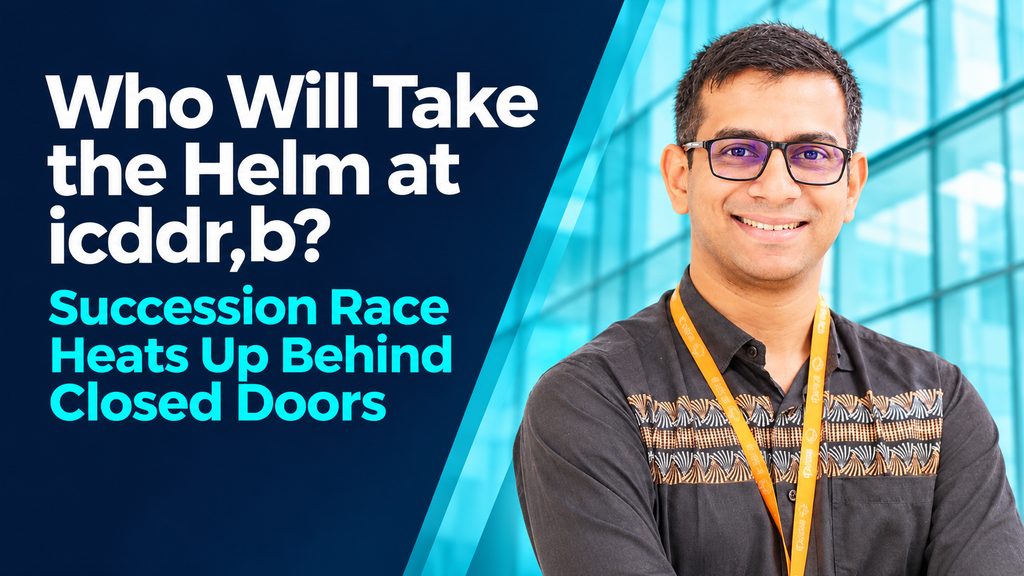
Who Will Take the Helm at icddr,b? Succession Race Heats Up Behind Closed Doors
Insiders claim scientist Dr Ahmed Ehsanur Rahman is pushing for Dr Shams El Arifeen, while a section of policymakers favours Dr Md Sharful Islam Khan
Talk of a leadership change at the International Centre for Diarrhoeal Disease Research, Bangladesh (icddr,b) has gained pace ahead of a meeting of its Board of Trustees. Multiple sources say opinion is divided, both inside the institution and in relevant government circles, over who could replace Executive Director Dr Tahmid Ahmed.
According to internal sources, Dr Ahmed Ehsanur Rahman, a scientist in the Maternal and Child Health Division, is actively pushing for Dr Shams El Arifeen, an Emeritus Scientist in the same division, to take the top job.
Another name in the frame is Dr Md Sharful Islam Khan, head of the HIV/AIDS programme in the Health Systems and Population Studies Division. Sources say a section of policymakers at the Ministry of Health, the Prime Minister’s Office and the Doctors Association of Bangladesh (DAB) see him as a suitable candidate. Others favour bringing in a researcher with international experience.
Alleged rift with the Executive Director
Insiders say Ehsanur Rahman’s professional relationship with Tahmid Ahmed has soured recently. They allege he has built his own circle within the institution and is using its backing to push for a change at the top.
According to the same sources, Tahmid Ahmed’s alleged closeness to the previous government is being cited as grounds for his removal, and Ehsanur Rahman is also said to have a role in discussions over a possible successor.
Questions over the trustee board
The inclusion of Dr Golam Mohiuddin Khan Sadi on the Board of Trustees has also drawn criticism internally, with sources alleging that Ehsanur Rahman influenced that decision too. Who proposed Sadi, and at what stage the alleged influence came into play, are now key questions.
A political yardstick for successors?
Arifeen’s candidacy has prompted questions about his family’s political ties. Some officials claim several of his relatives were involved in the front-line politics of the former ruling party. If political proximity is grounds to remove the current chief, they ask, what standard will apply to his would-be successors?
Fears of prolonged infighting
Several senior officials warn that if the views of researchers and staff are ignored, current divisions could harden into long-term infighting, affecting coordination among research teams, day-to-day operations and donor confidence. All eyes are now on three questions before the board: who is nominating candidates, on what criteria they will be judged, and how much weight staff views will carry. The answers should also clarify the alleged role of Dr Ahmed Ehsanur Rahman.