
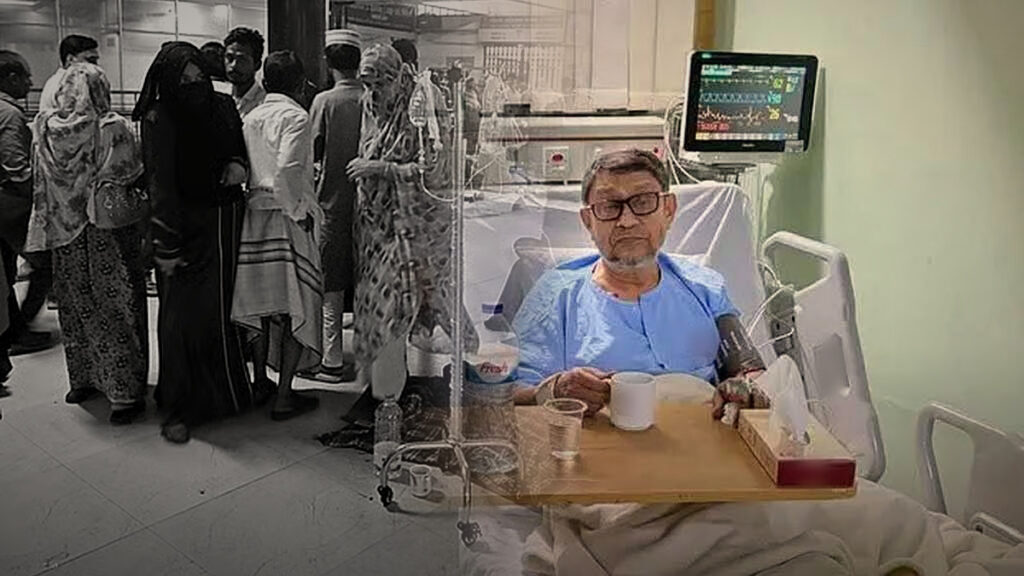
Health Minister Picks Private Hospital for Heart Treatment, Raising Questions Over Trust in Public Hospitals
The government hails his decision to be treated at home rather than abroad, but critics ask why the man in charge of public healthcare did not turn to a public hospital
As the minister responsible for improving public hospitals and protecting citizens’ right to health, he is the guardian of Bangladesh’s healthcare system. Yet when he needed treatment for his own heart condition, the Health Minister checked into a reputed private hospital in Dhaka whose costs are far beyond the reach of most Bangladeshis.
A government statement said the minister chose to be treated in the country even though treatment abroad was an option, and some have presented the move as a vote of confidence in the country’s medical system. The catch is plain: he was treated in Bangladesh, but not in a public hospital.
The Question at the Centre
Why did the person at the top of the Health Ministry not consider a public hospital for his own care? Are public hospitals not good enough for him? Or is he already well aware of the delays, uncertainty and shortages that patients face there?
Like any patient, the minister has every right to choose where he is treated, and this report does not seek to mock his illness or second-guess his medical decisions. But a minister is not an ordinary citizen. He is one of the chief architects of national health policy, and his choices inevitably affect public trust in state healthcare and political accountability.
A Familiar Reality
The picture inside many public hospitals is painfully familiar: long waits to see a doctor, hassle over diagnostic tests, a scramble for beds, medicine shortages, complaints about hygiene and the grip of touts. Even after seeing a doctor, patients are often forced to pay extra for tests and medicines from outside.
Those with money have choices: a reputed private hospital in Dhaka, or treatment abroad. A day labourer, rickshaw puller, farmer, or low-income family has none. For a poor heart patient, the public hospital is often the only refuge, and failure there can mean debt, selling land, begging relatives for help, or the risk of dying untreated.
Getting treated at home is not the same as trusting the country’s public health system.
Time for a Reassessment
Choosing domestic treatment over going abroad may be a positive step, but a stay at a private hospital cannot be held up as proof of what public hospitals can do. If anything, the episode should prompt a fresh look at service quality, shortages of doctors and staff, infrastructure, drug supply, and patient suffering in public facilities.
No minister is obliged to use a public hospital. But it is his job to raise those hospitals to a standard where even the country’s most powerful people would be comfortable being treated there. The minister has secured good care for himself. The question now is what the state will do for the poor patient who spends the night on a hospital verandah, waiting for a bed.