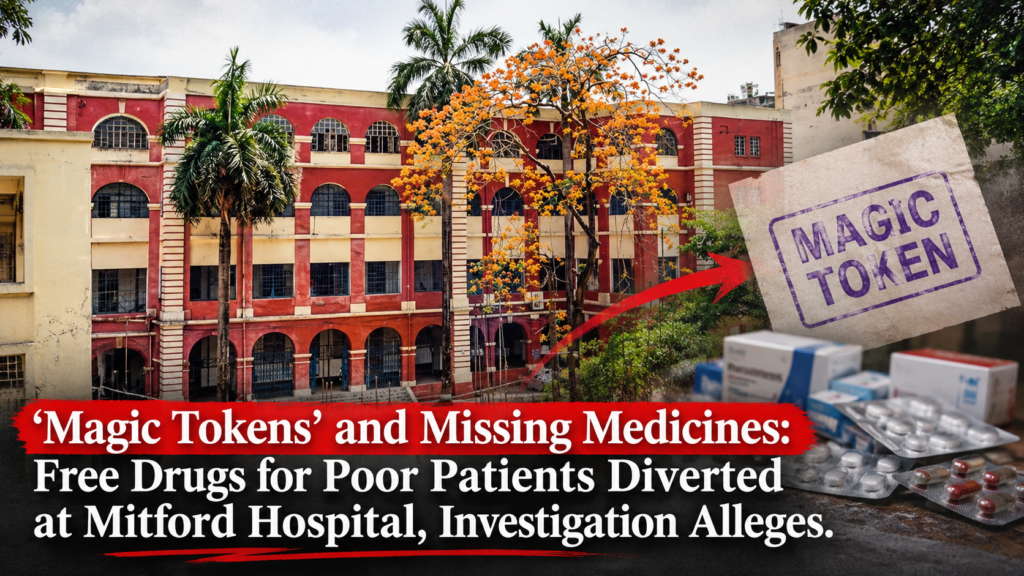
‘Magic Tokens’ and Missing Medicines: Free Drugs for Poor Patients Diverted at Mitford Hospital, Investigation Alleges
Staff, brokers, and Ansar members accused of collecting government medicines while patients wait in line, RTV reports
Free government medicines meant for poor patients at Sir Salimullah Medical College Mitford Hospital in Dhaka are being diverted to others through an organised network, according to a series of investigative reports by RTV.
The reports claim the system revolves around a special token used to collect medicines. Patients queue from dawn, yet many allegedly leave without the medicines they need. At the same time, some nurses, brothers (male nurses), ayas and ward boys were collecting medicines from the counter, the reports say. Members of broker syndicates and some Ansar members face similar allegations.
Tokens stamped with a doctor’s seal
According to RTV, medicines are often unavailable without a so-called ‘magic token’, which is prepared in front of doctors’ rooms under cover of prescriptions.
Three MLSS staff working outside a room in the outpatient orthopaedic department, Rezaul, Rubel and Yasin, are accused of using a doctor’s seal to supply tokens to members of the alleged smuggling network.
Medicines in a drawer, a pharmacy in Keraniganj
The investigation also points to alleged misappropriation of medicines allocated to admitted patients. Several nurses and hospital-linked individuals are named, among them nurse Asma Akter, Saddam Hossain and his wife Rokeya Akter Setu.
RTV claims a large quantity of government medicines was found in Asma Akter’s drawer, and that she runs a pharmacy in the Sonar Bangla Housing area of Keraniganj, where hospital medicines may be stockpiled. When RTV’s team posed as buyers, Asma’s husband delivered the medicines, the report claims. Asma Akter declined to comment.
Official response
The hospital director promised action over the recovery of government medicines from nurses, saying steps would be taken if complaints were received or if he witnessed it himself. The Director General of the Directorate General of Drug Administration declined to comment.
For low-income patients, a single medicine can be life-saving. If it never reaches them, the issue goes beyond poor management to the protection of public health and public resources.