
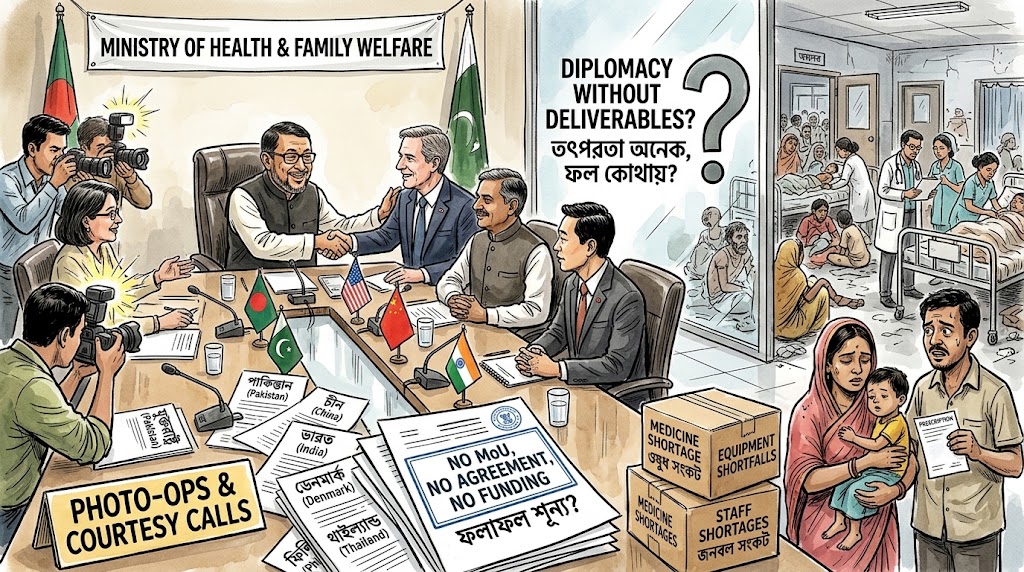
Diplomacy Without Deliverables? Health Minister’s Meetings Under the Scanner
Outcomes of the meetings with envoys remain unknown; coordination and purpose are in question
Since taking office, Health Minister Sardar Mohammad Sakhawat Hossain Bakul has met one foreign diplomat after another. Reports have appeared of his meetings with representatives of Pakistan, the United States, the Philippines, China, Thailand, Denmark and India. Yet what these meetings have achieved for the health sector remains unclear.
The published accounts carry courtesy-call descriptions and photographs, but make no mention of any agreement, memorandum of understanding, funding, technology transfer or training programme. The matter is reportedly being discussed within the administration as well.
Routine, but Why the Questions?
International cooperation on vaccines, medicines, medical technology, research and health worker training is now a recognized part of diplomacy, so a health minister meeting foreign representatives is not unusual in itself. The questions concern the outcomes, purpose and accountability of the meetings.
Analysts say effective health diplomacy is usually followed by measurable results, such as a MoU, a project, training or a policy decision. Without this, a meeting remains within the bonds of a courtesy call.
Coordination and Agenda Unclear
Ministerial-level contact with foreign governments is generally expected to be coordinated with the Foreign Ministry and the government’s established diplomatic framework. What the agenda of each meeting was, whether there was coordination with the Foreign Ministry before or afterwards, and which health ministry official is handling follow-up, none of this is known.
There is likewise no reliable information on whether this activity is the minister’s own initiative, part of the government’s wider diplomatic coordination, or the result of a directive at party level. The lack of clarity has fueled speculation in political circles, none of which has been substantiated.
A Sector in Crisis, a Question of Priorities
Meanwhile, the health sector is struggling with staff shortages, too few hospital beds, complications in medicine supply, equipment shortfalls and the mounting burden of out-of-pocket costs. Against this backdrop, those familiar with the sector say it is not unreasonable to question the minister’s time and priorities.
At the same time, it would be wrong to treat international cooperation and domestic administrative work as contradictory. Foreign cooperation often brings funding, technology and expert support to the health sector. The central question is whether those benefits reach hospitals, doctors, nurses and ordinary patients.
Questions Still Unanswered
- What specific decisions were reached in the meetings with India, China, the United States, Denmark, Thailand, the Philippines and Pakistan?
- Has any agreement, project or cooperation programme been launched?
- Were the meetings coordinated with the Foreign Ministry?
- Who is responsible for follow-up after the meetings?
The number of meetings does not in itself prove any irregularity or political motive. But when the purpose, agenda and outcomes are not made public, questions will remain. The Health Ministry’s response will be added if it is received.