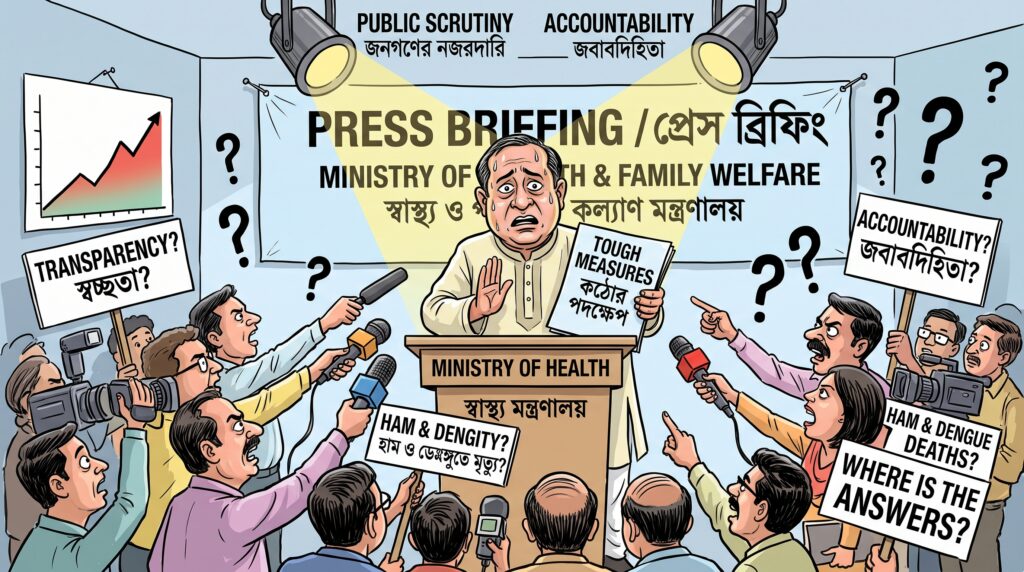
Health Minister’s Tough Measures Face Questions of Transparency and Accountability
Hospital inspections, license cancellations and action against doctors have drawn attention, while allegations over payments, assets, political ties and decisions remain contested
- Six Newborn Deaths, License Cancellation and Alleged Payments
- Unannounced Inspection, 58 Doctors and Due Process
- Chandpur Transfer Order Reversed in Two Hours
- How Much Progress Toward a “Syndicate-Free” Ministry?
- Past Responsibility or Present-Day Solutions?
- Allegations Around the Minister’s Political Circle
- Earlier Questions About Wealth
- Statements and Results: The Larger Test
- Questions Still Requiring Answers
Six Newborn Deaths, License Cancellation and Alleged Payments
In June 2026, the government cancelled the license of Ad-din Hospital in Moghbazar, Dhaka, after six newborns died there. During the investigation, reports also highlighted a bakery or oven facility on the hospital roof. Questions about management, safety, and the care environment coincided with the minister’s public display of a tough stance.
At an event in Narsingdi, Bakul alleged that hospital authorities had offered him crores of taka to protect the facility’s license. The executive director of Ad-din Foundation later denied the allegation at a press conference and challenged the minister to provide evidence.
The allegation raises basic questions: is there a document, communication record, witness account, or investigation report supporting the claimed offer? If so, has it been made public? If not, what was the basis for making such a serious claim?
The legality of government action against the hospital and the alleged offer of money must be considered separately. An administrative decision does not establish a financial transaction, just as the hospital’s denial does not by itself disprove the allegation. Documents and an independent inquiry are needed to determine what happened.
Unannounced Inspection, 58 Doctors and Due Process
The minister’s strict approach also came into view during a visit to the National Institute of Mental Health and Hospital. On an unannounced inspection in March 2026, he criticised late attendance by doctors and the hospital’s unclean environment. Reports later said cautionary or show-cause measures were taken against 58 doctors.
Ensuring doctors are present on time and patients receive proper care at public hospitals is an administrative responsibility. But questions remain about how the action was applied: was each complaint checked individually, were doctors given the opportunity to explain their absence, and was there a route for administrative review of decisions based on the inspection?
Discipline and accountability are important goals, but the process used determines whether an administrative measure is fair and effective.
Chandpur Transfer Order Reversed in Two Hours
Questions over decision-making sharpened after an incident in Chandpur. According to a Prothom Alo report, the minister arrived for an unannounced inspection at Haimchar Upazila Health Complex at about 10:30 a.m. on 9 August 2026. He noticed what the report described as irregularities and mismanagement, as well as a shortage of rabies vaccine. He then called the ministry and ordered the “stand release,” or withdrawal, of Civil Surgeon Mohammad Nur Alam Din.
At around 12:30 p.m., after visiting Chandpur 250-bed Government General Hospital and speaking with the civil surgeon, Bakul withdrew the order. He told journalists he was satisfied with the cleanliness at that hospital. The civil surgeon told Prothom Alo the minister had been somewhat angry because the rabies vaccine had run out in Haimchar, but later forgave him.
An order to remove a senior district health official is a serious administrative step. Its reversal within two hours prompts questions about what information had been checked beforehand. Was the directive issued before responsibility for the stockout had been established—whether it lay with the civil surgeon or with the supply and procurement system?
The published report does not cite an inquiry or new evidence as the reason for withdrawing the order. Instead, it describes the minister’s satisfaction at another hospital and his conversation with the civil surgeon. The language of “forgiveness” also raises questions: accountability is generally an institutional process, not a matter of personal anger or pardon. A decision made in the heat of the moment and reversed soon after can weaken confidence in administrative consistency and suggest that immediate approval matters more than rules or evidence.
The debate has also left the underlying supply problem in the background. Rabies vaccine is life-saving for people bitten by animals, including dogs. The published reports do not explain why Haimchar ran out, when new supplies were expected, or what stocks were available in other upazilas.
It could be argued that recognising an error and correcting a decision is positive. The minister also promised quick action on infrastructure, staffing and ICU problems at Chandpur Sadar Hospital. Whether those assurances are implemented remains to be seen; a verification process before the initial order could have avoided the need to reverse it.
How Much Progress Toward a “Syndicate-Free” Ministry?
Bakul has repeatedly spoken of taking a firm line against corruption and syndicates in the health sector, and has pledged to make the ministry fully corruption-free. Yet the sector’s longstanding problems are complex. Allegations of irregularities and influential contractor groups have surrounded the purchase of medicines and equipment, cleaning, food supply, construction and service contracts at public hospitals.
The progress is best assessed through records rather than declarations. Since the minister took office, how many major tenders have ensured competition? How many contracts have been cancelled? How many contractors or officials have faced penalties over alleged irregularities? What has changed in public-hospital purchases of medicines and equipment? Without answers, the claim of a “syndicate-free” health sector is difficult to measure.
Past Responsibility or Present-Day Solutions?
The minister has blamed corruption and financial plunder under previous governments for the current health-sector crisis. He has said that past irregularities left upazila health complexes without enough money even for basic supplies such as gauze, bandages, and syringes.
Investigating past wrongdoing is necessary. A serving minister must also address current shortages. Publishing details of what each upazila health complex lacks, how much funding it received, what medicines and equipment were supplied, and how the money was spent would help show what is changing.
Accountability for past failures and solutions to current problems can proceed at the same time. Both are necessary for effective administration.
Allegations Around the Minister’s Political Circle
Claims have also been made about people in Bakul’s political circle. Toward the end of 2025, local reports carried allegations that some of his followers in Narsingdi were involved in land grabbing, control of the sand trade, extortion, and favouritism. Allegations also surfaced that some Awami League leaders and activists were being indirectly protected.
These claims require verification. Publication in local political statements or news reports does not make an allegation proven. Relevant cases, official records, land documents, business transactions and the accounts of those concerned would be needed to assess them.
At a political meeting in Monohardi on 28 August 2026, Bakul said the BNP would have no place for extortionists, land grabbers, terrorists or criminals. The practical test of that declaration will be what the party or law-enforcement authorities do if allegations arise against someone in his political circle.
Earlier Questions About Wealth
Questions about Bakul’s assets also predate his current role. In September 2024, news reports said the ACC was investigating allegations of abuse of power and acquisition of illicit wealth. Reports at the time described inquiries into flats, land in Dhaka and investments in various organisations.
An investigation is not proof of an offence. A final assessment requires knowing the outcome, whether a case was filed and whether declared assets matched the information gathered during the inquiry.
Past reporting also discussed assets in his wife’s name, including several Gulshan flats and shares in various companies. Assets held by a family member do not by themselves prove illicit wealth. Their source, income, purchase price, ownership, and tax records are relevant.
Statements and Results: The Larger Test
Bakul has also spoken about accountability and political change. In November 2024, he urged the interim government to hold elections promptly in line with public expectations. After taking charge of the Health Ministry, he now faces a similar test of administrative accountability.
A minister’s performance cannot be judged only by the number of officials issued show-cause notices or institutions penalised. The questions include:
- Has service quality improved at government hospitals?
- Have medicine shortages declined?
- Are doctors attending work more regularly?
- Have competition and transparency improved in public procurement?
- Are corruption allegations investigated and acted on equally, regardless of party or identity?
Questions Still Requiring Answers
Several questions about the ministry’s work under Bakul remain important:
- What evidence supports the allegation that Ad-din Hospital offered crores of taka?
- What process was followed in taking action against the 58 doctors?
- What information led to the order concerning Chandpur’s civil surgeon, and why was it reversed two hours later?
- Why did Haimchar and other upazila-level facilities face rabies-vaccine shortages, and what has been done to address them?
- What measurable results have the ministry’s anti-corruption and anti-syndicate efforts produced?
- What has changed in procurement and tenders at government hospitals?
- Has any independent inquiry examined the allegations against people in the minister’s political circle?
- What was the outcome of the earlier ACC inquiry?
- How much are ordinary people benefiting from the announced changes in healthcare?
These questions need answers grounded in documents, government decisions, investigation reports, court records, procurement data and statements from the people concerned—not political claims alone.
Decisions by the Health Ministry can directly affect patients, doctors, hospitals and millions of people. The minister’s firmness may matter, but accountability for how that firmness is exercised matters just as much.
The central question is not simply how strict Bakul is. It is whether each decision is evidence-based and transparent, and whether the same rules are applied to everyone. The answer will show how far the ministry’s promises of change have become real reform.